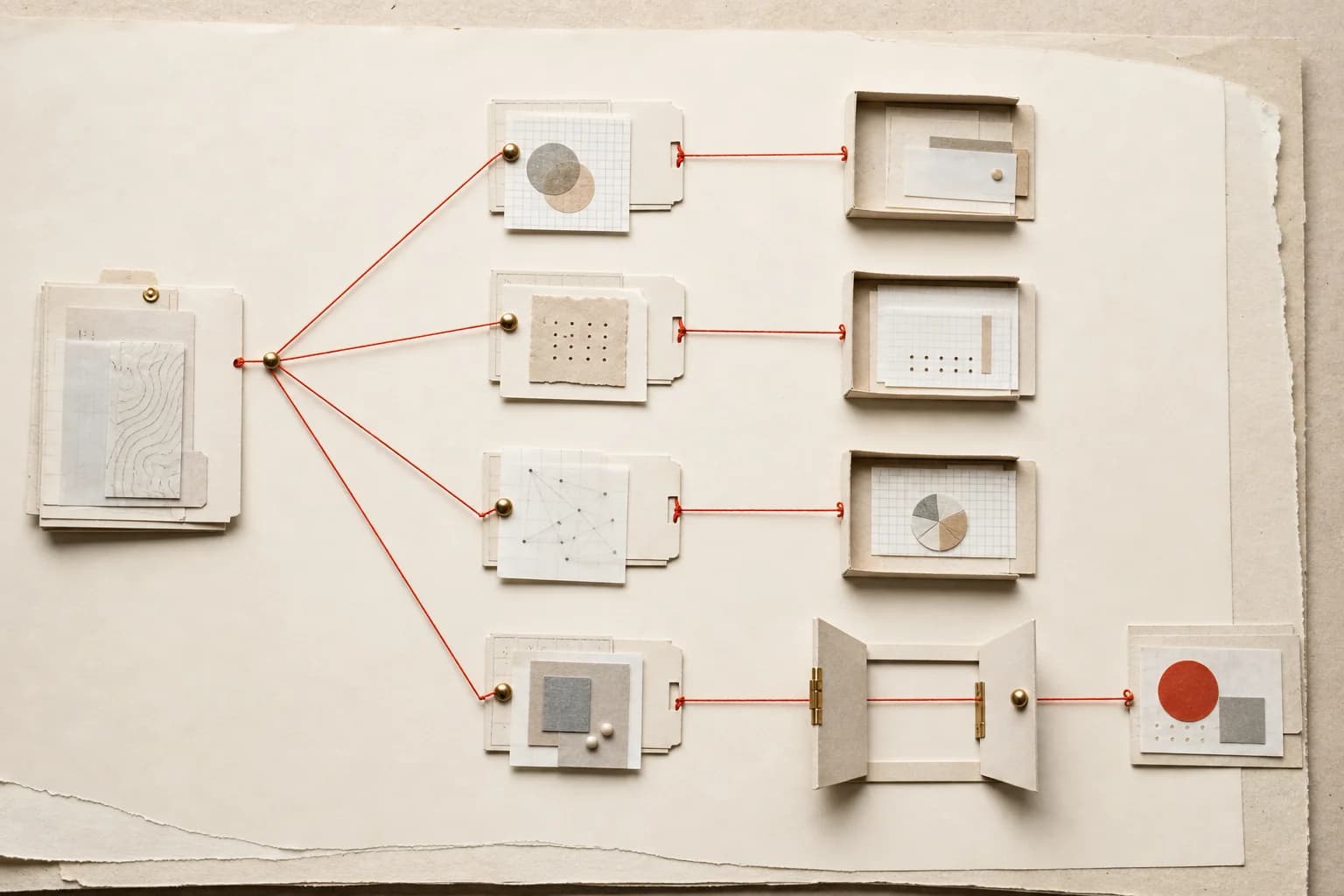
RAG vs AI Agents: Which Architecture Does Your Business Need?
Compare standard RAG, agentic RAG and action-taking AI agents across use cases, cost, latency, evaluation, security and implementation complexity.

Key takeaways
- RAG retrieves trusted context; an agent controls the sequence of work and may take actions.
- Standard RAG is usually faster, cheaper and easier to evaluate for straightforward knowledge questions.
- Agentic retrieval adds value for multi-source, multi-step or ambiguous research questions.
- Separate retrieval quality, answer quality and action safety in your evaluations.
The shortest useful definition of each system
Retrieval-augmented generation gives a language model selected information at answer time. The application searches approved sources, places relevant passages in the model context and asks for a grounded response, often with citations. The workflow is designed in advance.
An agent uses a model to decide the next step. It may search, inspect the result, run another query, call a calculator, update a ticket or ask for human approval. Agentic RAG places that decision loop around retrieval; an action agent extends the loop into systems where business state can change.
How a standard RAG pipeline works
The ingestion side extracts documents, divides them into useful chunks, records metadata and creates searchable representations. The query side interprets the question, retrieves candidates, ranks them, builds the model context and generates an answer constrained by the retrieved evidence.
For an employee asking “What is our travel meal limit in Toronto?”, one search against the current policy index may be enough. The fixed path makes latency and cost predictable. It also makes evaluation easier because the team can test whether the right passage was retrieved before judging the prose.
When agentic RAG earns its added complexity
Microsoft’s current architecture guidance recommends agentic RAG for multi-step reasoning, dynamic source selection, query decomposition, iterative refinement, or retrieval followed by action. A question such as “Which products sold in Canada have an open recall and inventory on hand?” may require a catalogue query, regulatory search and inventory lookup before comparison.
Do not use an agentic loop to make a simple FAQ look advanced. Every reasoning step adds model calls, latency, failure paths and logs to inspect. Use it when the system cannot know the necessary searches before seeing intermediate results.
When you need an action-taking agent
Move beyond retrieval when the desired outcome changes a business record or communicates externally. A support agent might retrieve order and policy data, determine eligibility, prepare a return, request approval above a dollar threshold and update the ticket. Retrieval supplies evidence; tools change state.
Grant tools separately. Read-order, draft-return and issue-refund should not share one broad function. Narrow tools make permissions, approval and failure analysis clearer. Start with read-only access and draft outputs, then add reversible writes before irreversible or financial actions.
Evaluate retrieval before blaming the model
Create a test set of real questions with the expected source passages. Measure whether retrieval returns the necessary evidence near the top, whether access filters exclude unauthorized documents and whether the answer cites what it actually used. Poor chunking, stale indexes and weak metadata often look like model hallucination.
Then evaluate groundedness, completeness and refusal. A good system should say that evidence is missing rather than fill the gap from general model memory. For agents, add tool selection, parameter accuracy, stop-condition, approval and end-state tests.
Security changes when retrieval becomes action
RAG must preserve document-level permissions during indexing and retrieval. An employee should not receive a salary document because its embedding was similar to a question. Record source identity, permission context, retrieved passages and the final citation for audit.
Agents add prompt injection and excessive-agency risks. Treat retrieved content as untrusted data, not instructions. Validate tool inputs, restrict credentials, require approval for consequential actions and cap loops, spend and transaction size. A model refusal is not a substitute for authorization.
A staged architecture decision
Stage one is search with links. Stage two adds grounded generation. Stage three adds query decomposition or multi-source retrieval. Stage four adds read-only tools. Stage five adds approved actions. Advance only when evaluations show the current stage cannot meet the business outcome and the expected gain justifies the new risk and cost.
This path also creates evidence for the next investment. Search logs reveal missing content. RAG evaluations reveal answer limits. Draft actions reveal policy exceptions. By the time the system can change business state, the team has already learned where it fails.
About the author
Jayson Hao
Founder of Innovation Trigger Lab and a University of Toronto Computer Science graduate with an AI/ML focus. He designs and ships production RAG systems, AI chatbots, web platforms and mobile products.
View profileFrequently asked questions
Is RAG the same as an AI agent?
No. RAG retrieves information to ground a model response. An agent lets a model control workflow steps and select tools. An agent can use RAG as one of its tools.
Is agentic RAG better than standard RAG?
Only for workloads that need multi-step or dynamic retrieval. Standard RAG is often the better choice for a single known corpus because it is faster, cheaper, simpler and easier to evaluate.
Should a company build RAG before an AI agent?
If the workflow depends on company knowledge, first prove that the system can retrieve and cite the right evidence. Add agent decisions and actions after retrieval quality meets a defined bar.
Sources and further reading
- 1.Retrieval-augmented generation in Azure AI SearchMicrosoft Learn
- 2.Develop an agentic RAG solutionMicrosoft Learn
- 3.